Welcome to thatlinuxbox.com Monday, October 12 2026 @ 12:42 PM UTC
How to pass the AWS Certified Solutions Architect Associate Exam (SSA-C03)

- Wednesday, November 06 2024 @ 05:58 PM UTC
- Contributed by: Dan Stoner
- Views: 2,537



1. Start with the Exam overview:
https://aws.amazon.com/certification/...associate/
2. Buy and read the Sybex (Wiley) AWS Certified Solutions Architect Study Guide 4th edition (or later). This book is particularly good for those with existing IT / physical server experience. Use the practice questions at the end of each chapter.
3. Use the Wiley online question test bank that is included with the book purchase. Note that a small percentage of the questions had out-dated (wrong) answers or were just poor / ambiguous questions in the first place... but overall the test bank is helpful.
4. Read the Well-Architected Framework materials and know the Pillars -
web-based summary:
https://docs.aws.amazon.com/en_us/wel...ework.html
5. Read as many AWS service technical whitepapers or FAQs as possible, especially on areas where one performed poorly on the sample tests.
Amazon EC2 - https://aws.amazon.com/ec2/faqs/
Amazon S3 - https://aws.amazon.com/s3/faqs/
Amazon VPC - https://aws.amazon.com/vpc/faqs/
Amazon Route 53 - https://aws.amazon.com/route53/faqs/
Amazon RDS - https://aws.amazon.com/rds/faqs/
Amazon SQS - https://aws.amazon.com/sqs/faqs/
Amazon CloudFront - https://aws.amazon.com/cloudfront/faqs/
6. Learn Security and IAM
https://docs.aws.amazon.com/whitepape...cture.html
https://docs.aws.amazon.com/whitepape...ntrol.html
7. Learn Subnetting
https://docs.aws.amazon.com/vpc/lates...locks.html
Free subnetting questions - https://subnetting.org/
Youtube series -
EP 1 - https://www.youtube.com/watch?v=BWZ-MHIhqjM
EP 5 - https://www.youtube.com/watch?v=Pj_ubhpi0WQ
Note that during the exam you may not write any notes, you would need to memorize the subnetting cheat sheet and use it inside your head!
8. Use AWS Skillbuilder - "Free Exam Prep Standard Course" (there is also a longer paid training course that includes labs that I did not use). The free course includes AWS Official Practice Question Sets thru benchprep.com
9. For those content areas with poor practice test performance, go build real resources in AWS to cement the concepts.
10. Additional resources that I didn't actually use but would use if I had failed the test, or if I just had more time to spend on the certification:
AWS Well-Architected Labs
(requires an AWS account to deploy actual resources)
https://www.wellarchitectedlabs.com/
The full Well-Architected Framework document (over 900 pages!):
https://docs.aws.amazon.com/pdfs/well...mework.pdf
- Comments (0)
Certifications and new Job Title
- Wednesday, November 06 2024 @ 03:48 PM UTC
- Contributed by: Dan Stoner
- Views: 2,582
First, IRIS merged with UNAVCO to become EarthScope Consortium.
I was promoted from Database Administrator to Cloud Operations Engineer III and joined the Cloud Enablement team.
I also earned a couple of industry certifications:
Certified Kubernetes Application Developer (CKAD)

AWS Certified Solutions Architect - Associate

- Comments (0)
Floating Point and Decimal Numeric Types
- Monday, January 10 2022 @ 05:35 PM UTC
- Contributed by: Dan Stoner
- Views: 2,242
Different programming languages and data storage engines use different names for IEEE 754 double-precision floating point (aka "approximate") numbers:
| Language / Engine | IEEE 754 double-precision data type name |
|---|---|
| SQL (Strict Standard) | DOUBLE PRECISION |
| PostgreSQL | double precision or float8 or float |
| Avro | double |
| Python | float or sqlalchemy.Float |
| Java | Double |
| Perl | Floats are platform dependent (double precision on 64-bit x86) |
| C | double |
| Go | float64 |
| Rust | f64 |
Fixed precision Decimal types are often but not always provided by the stdlib:
| Language | Fixed precision / decimal data type name |
|---|---|
| SQL (Strict Standard) | NUMERIC |
| PostgreSQL | numeric |
| Avro | NA |
| Python | Decimal |
| Java | BigDecimal |
| Perl | Math::BigFloat (library) |
| C | NA |
| Go | decimal (via github.com/shopspring/decimal library) |
| Rust | Decimal (via rust_decimal library) |
Floating point naming mahem:
The SQL Standard (SQL-99) defines the following approximate numeric data types:
- FLOAT specifies the data type approximate numeric, with binary precision equal to or greater than the value of the specified _precision_. The maximum value of _precision_ is implementation-defined. _precision_ shall not be greater than this value.
- REAL specifies the data type approximate numeric, with implementation-defined _precision_.
- DOUBLE PRECISION specifies the data type approximate numeric, with implementation-defined precision that is greater than the implementation-defined _precision_ of REAL.
PostgreSQL provides 'real' and 'double precision' but also supports the aliases 'float', 'float8', and 'float4'. The only alias that maps to 'real' is 'float4' (single precision). 'float' maps to 'double precision'.
At least in Python, where 'float' is the language data type for double precision floating point, a database abstraction layer would need to make some bad choices to end up with single precision / Real data type in the persistence layer when talking to a PostgreSQL backend.
The Avro storage enginue uses 'float' for single precision, and only 'double' is mapped to IEEE 754 double precision. At this point it is dubious to me what a python 'float' would get mapped to when writing to Avro.
- Comments (0)
New job - Database Administrator with IRIS
- Tuesday, May 04 2021 @ 02:50 PM UTC
- Contributed by: Dan Stoner
- Views: 2,913

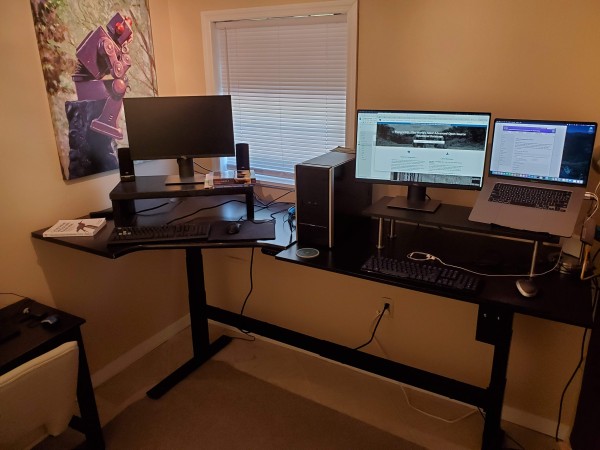
This position is a true Remote job, so I will be working from my home office and hopefully occasionally from other interesting locations.
I assembled the sit-stand desk in my office from an UPLIFT Standing Desk Frame (V2-Commercial) and some used desk surfaces that I picked up from our local salvage yard, The Repurpose Project. This frame is fantastic, remarkably stable (no bounce when typing), and strong enough to support a lot of equipment or heavy surfaces.
- Comments (0)
Laptop Screen Height and Remote Work
- Wednesday, March 25 2020 @ 12:31 AM UTC
- Contributed by: Dan Stoner
- Views: 6,244
I know some people who stand up at a table or breakfast bar and use their laptops, but that is a terrible neck angle for long periods of time.
If your laptop will open to 180 degrees, then the following configuration with an external keyboard and mouse may help the screen position considerably:
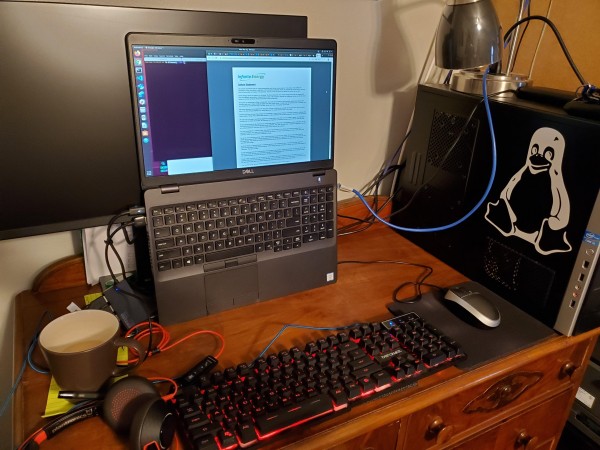
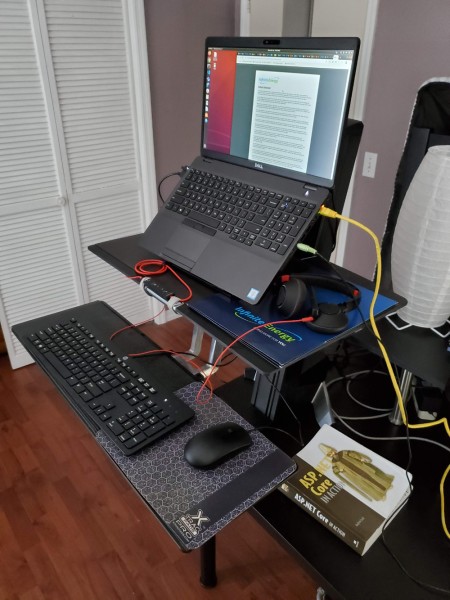
Otherwise, I suggest a laptop stand such as this one from 1home:
https://www.amazon.com/gp/product/B077JZSBS2
which works very well compared to some others I have tried.
Here I am using it in combination with my Ergotron WorkFit sit-stand workstation:
- Comments (0)
 RSS Feed for this blog
 Twitter
 LinkedIn
 GitHub